For Immediate Release
Contact: Amy Day
Tel: 515.271.0344 (o)
515.612.0775 (c)
aday@desmoinesartcenter.org
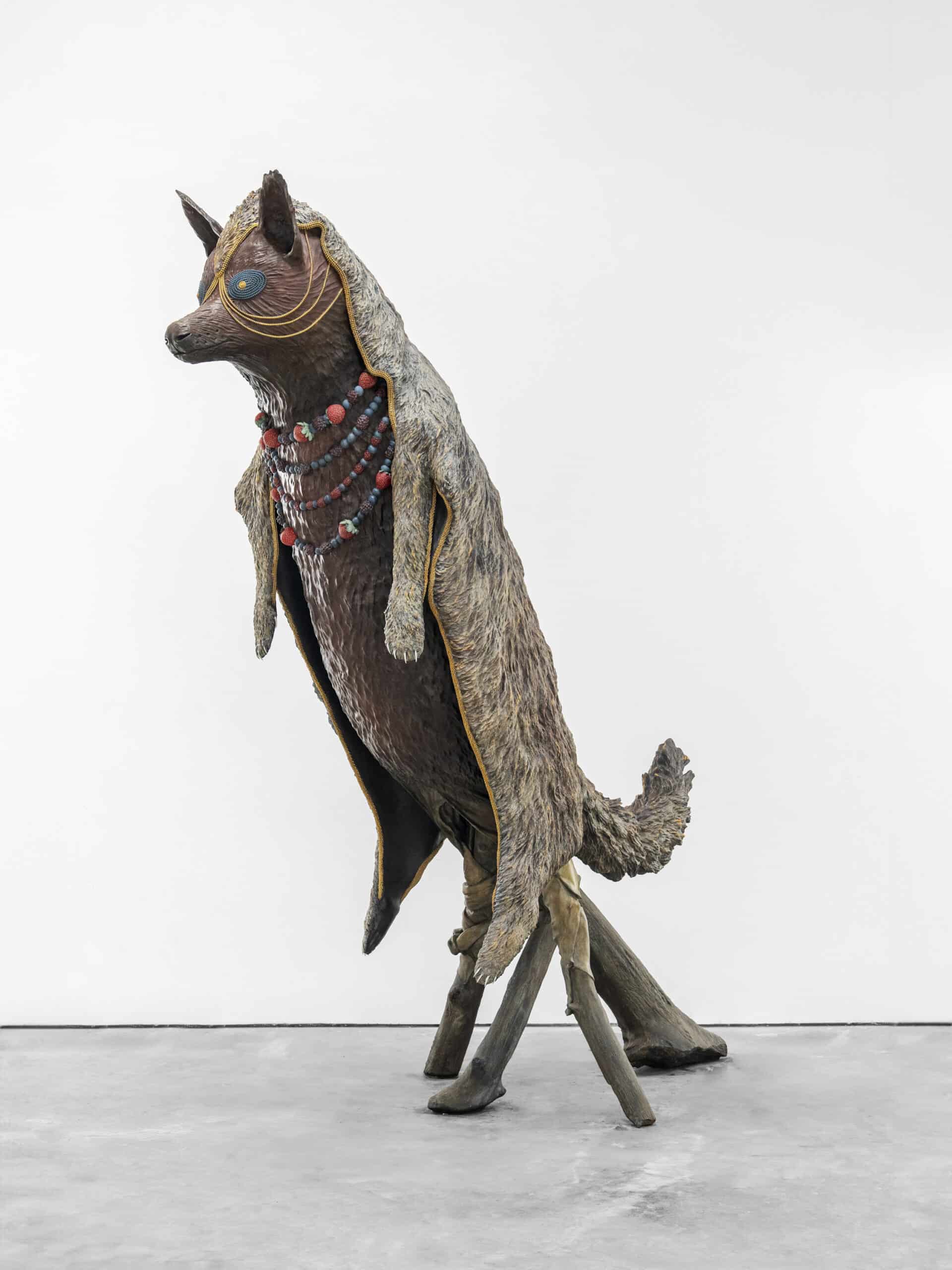
DES MOINES, IOWA (August 2026) — The Des Moines Art Center is thrilled to announce the acquisition of Jeffrey Gibson’s monumental sculpture nashoba holba / wayaha / coyote / they are witty and transform themselves in order to guide us. Originally presented at the Metropolitan Museum of Art, New York for the 2025 Genesis Facade Commission, Gibson’s sculpture is a testament to the beauty, complexity, and intelligence of the animal kingdom. Its purchase follows on the heels of Gibson’s October 2025 visit to Des Moines, when he delivered the Art Center’s annual Fingerman Lecture, endowed by Lois and the late Dr. Louis Fingerman.
Gibson is one of the most prominent artists of his generation. His work combines the materiality and methods of Indigenous cultural traditions from North America, with the forms of modernist abstraction and regularly draws upon a broad range of references pulled from literature, popular culture, philosophy, and history. A member of the Mississippi Band of Choctaw Indians and of Cherokee descent, Gibson represented the United States at the 2024 Venice Biennale and is the recipient of numerous awards, including a 2019 MacArthur Fellowship.
nashoba holba / wayaha / coyote is one of four sculptures commissioned by The Met to transform the iconic niches of its Fifth Avenue Facade. Each sculpture depicts an anthropomorphized animal, in this case a coyote. The coyote’s specific significance varies within North American Indigenous mythology, but it is generally understood as a cunning trickster and agile shapeshifter. nashoba holba / wayaha / coyote is embellished with the pelt of another coyote, evoking its role as a shapeshifter, which it wears draped around its shoulders like a cape, and necklaces of berries and beads. The work was inspired by Gibson’s longtime engagement with the philosopher Jacques Derrida’s book The Animal That Therefore I Am, also used as the title of The Met installation, which examines the violence animals are subjected to at the hands of humans. nashoba holba / wayaha / coyote invites viewers to consider what animals have endured, and the lessons they may be able to teach us.
“I’m thrilled to be able to represent this magnificent sculpture in the Des Moines Art Center’s collection,” says Kelly Baum, John and Mary Pappajohn Director and CEO. “Like the very best of Gibson’s work, nashoba holba / wayaha / coyote is joyful and incisive, jubilant and polemical. It is a work that will serve, as the artist intended, for reflection and discussion on issues that have always and will always concern our public, namely humanity’s ethical obligation to the creatures with which it shares the planet.”
nashoba holba / wayaha / coyote is the result of an iterative, labor-intensive process that marks the embrace of a new sculptural language in Gibson’s practice. The artist first created a mixed-media maquette which integrated materials like driftwood, beads, and cloth. In close collaboration with U.A.P. (Urban Art Projects), a fine art foundry and fabricator in Newburgh, New York, the maquette was scanned, digitally sculpted, and cast into bronze. The intricately detailed bronze sculptures were patinated by hand to evoke beadwork and textiles drawn from a range of Indigenous visual languages, resulting in a large-scale form that blends the animate and the inanimate.
nashoba holba / wayaha / coyote was acquired directly from the artist and his galleries, Hauser & Wirth and Sikkema Malloy Jenkins. Funds were provided by the Coffin Fine Arts Trust, established by the Estate of Winnie Ewing Coffin (1868-1937), a visionary philanthropist who arranged for the creation of a Trust to support the acquisition of art by a future museum in the city of Des Moines. In 1947, the Art Center was named the beneficiary of that Trust. To date, the Coffin Fine Arts Trust has supported the purchase of 126 exceptional works of art in all media by distinguished artists such as Francis Bacon, Eva Hesse, Ellsworth Kelly, Paul Klee, Martin Puryear, Robert Rauschenberg, Auguste Rodin, Fred Wilson, and, most recently, Firelei Baéz, Lari Pittman, and Arlene Shechet.
For more information or to request images, contact Senior Director of Communications and Marketing Amy Day at aday@desmoinesartcenter.org.
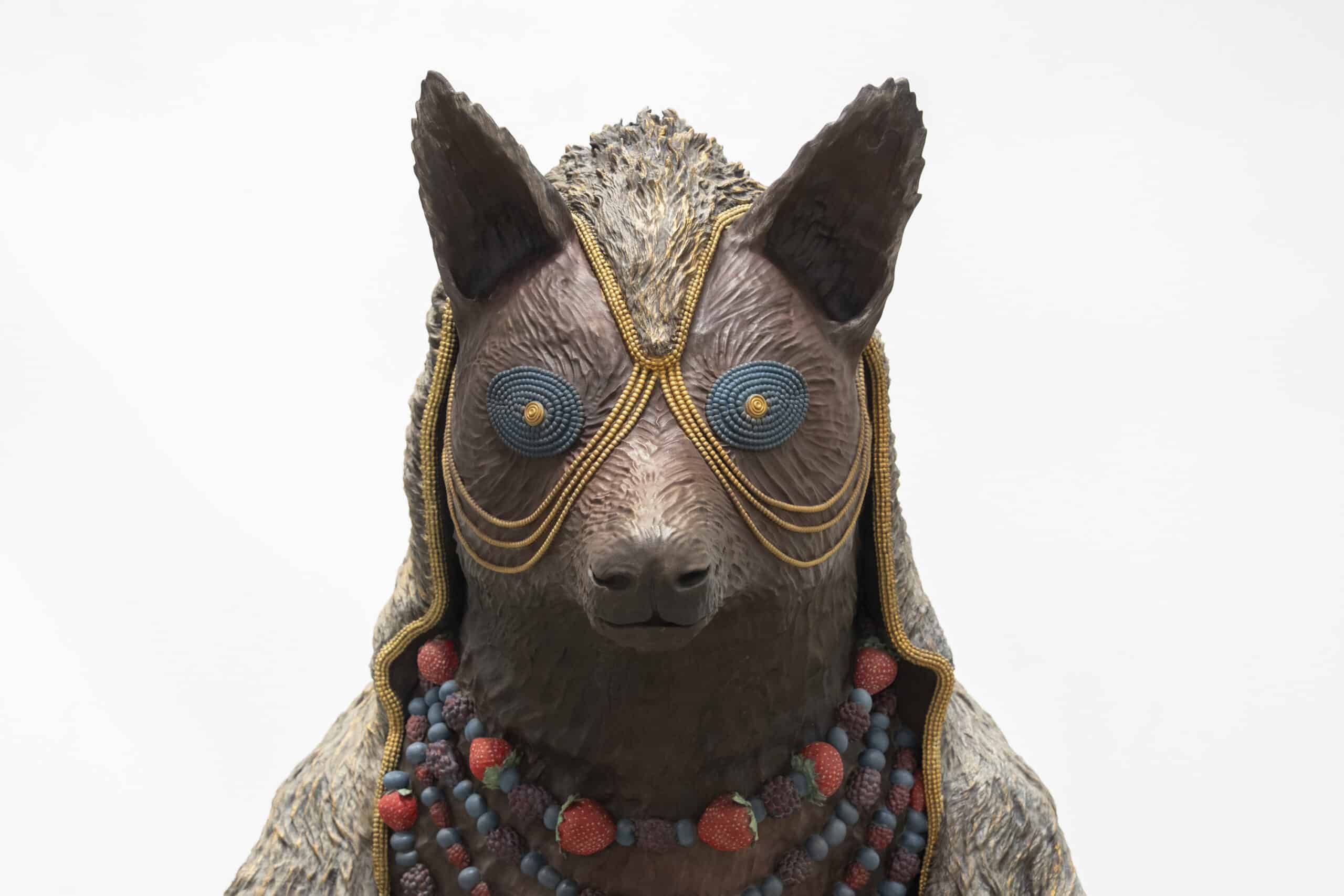
Images: © Jeffrey Gibson. Courtesy the artist and Hauser & Wirth. Photo: Chris Roque, courtesy of UAP | Urban Art Projects.
About the Des Moines Art Center
The Des Moines Art Center is a vibrant, AAM-accredited (American Association of Museums) institution located in the capital city of Iowa that welcomes over 300,000 visitors annually from across the country and around the globe. Its historic campus consists of three buildings designed by major architects of the 20th century—Eliel Saarinen, I. M. Pei, and Richard Meier—incorporated into the natural landscape of Greenwood Park. The Art Center is home to one of the strongest collections of 20th- and 21st-century art in the region, and it hosts a series of ground-breaking exhibitions and lectures each year featuring artists known regionally, nationally, and internationally. The experimental art for which the Art Center cares is reflected in its creative offerings, including a celebrated education program that prioritizes access and collaboration, an art school with studio classes for all ages, and the John and Mary Pappajohn Sculpture Park, situated on 4.4 acres in downtown Des Moines.
###